
The science behind scent, memory, and spatial experience
Among all human senses, smell is the most directly connected to emotion and memory. While sight and hearing first pass through several processing centers in the brain, smell follows a much shorter neurological route.
Odor signals travel from the nose to the olfactory bulb, which then sends information directly to the limbic system — the part of the brain responsible for emotion and memory.
This is why a simple scent — perfume, wood, coffee, or rain — can instantly transport someone back to a place or moment from years ago.
You can read more about this neurological pathway in this Harvard research article:
👉 How scent, emotion, and memory are intertwined
Smell and Memory — The “Proust Effect”
Scientists describe odor-triggered memories as odor-evoked autobiographical memories.
Research shows that memories triggered by scent are often:
• more emotional
• more vivid
• more personal
Brain scans demonstrate that smell activates the amygdala and hippocampus — the same brain areas responsible for emotional memory formation.
Because of this connection, scent memories often feel stronger than memories triggered by visual images.
Further reading about the link between smell and memory:
👉 The connections between smell, memory and health
Smell Influences Mood and Behavior
Scientific studies show that scent does not only affect memory — it also influences mood and behavior.
Research in neuroscience demonstrates that olfactory stimulation can alter emotional state, cognition, and stress levels.
Certain fragrances are associated with measurable psychological effects:
Lavender → relaxation
Citrus → increased alertness
Rosemary → improved concentration
Because of these effects, scent is widely used in:
• wellness spaces
• hospitals
• hospitality environments
• retail design
The Power of Scent in Retail and Architecture
Environmental psychology studies show that scent can influence how people behave in a space.
In one retail study, researchers found that the right scent intensity can increase sales significantly and improve customer mood.
Other studies demonstrate that a pleasant ambient scent can make visitors stay longer in a store or environment, increasing engagement with the space.
More research about scent marketing:
👉 Using scent to lift customers’ moods (Rotterdam School of Management)
Smell and Brain Health
Recent neurological studies suggest that smell also plays an important role in long-term brain health.
Research shows that olfactory stimulation can improve memory performance and may even slow cognitive decline.
Scientists are now studying “olfactory training” — repeated exposure to scents — as a method to stimulate memory centers in the brain.
Smell in Sensory Architecture
For centuries architecture focused mainly on visual design.
But modern sensory research shows that environments are experienced through multiple sensory layers.
In sensory architecture, smell functions as an invisible design element.
It can:
• create emotional identity
• anchor memories to places
• influence mood
• strengthen brand recognition
• enhance spatial immersion
When scent is integrated with light, sound, materials, and taste, spaces become fully sensory environments.
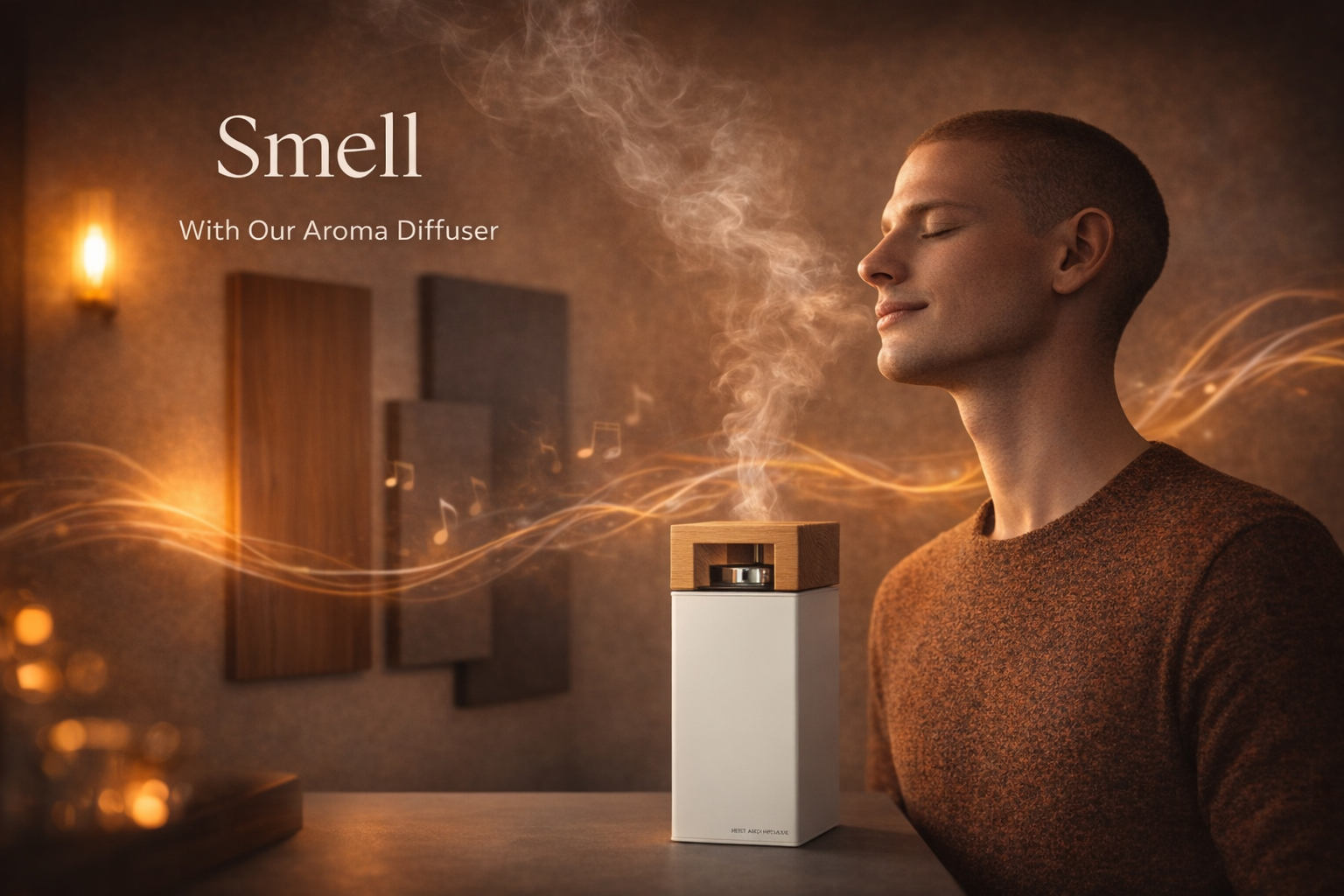
Smell in the SHOTT Sensory Framework
Within the SHOTT philosophy used in the YourSenses ecosystem, smell forms the emotional foundation of spatial experience.
S — Smell
Emotional memory and atmosphere
H — Hear
Soundscapes and acoustic identity
O — Observe
Light, art, and visual perception
T — Touch
Materiality and physical interaction
T — Taste
Experience, culture, and intuition
Together these senses create environments that people do not simply see —
they remember.
No responses yet