Touch — the sense that makes design real
Among all human senses, touch is the one that turns observation into connection.
We may first notice a space with our eyes, but the moment we reach out and touch a material, an object, or a surface, the experience becomes physical and personal.
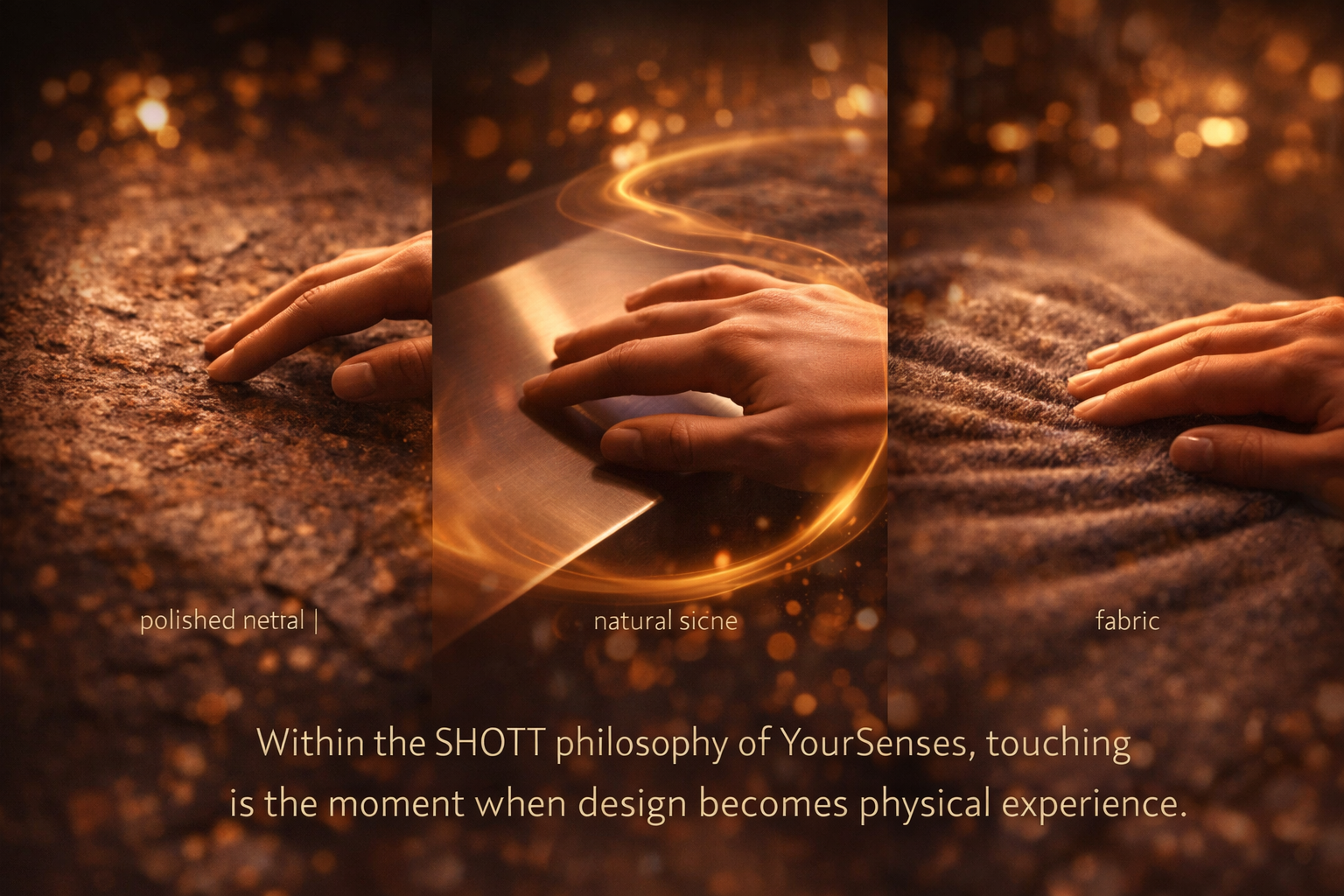
Texture, temperature, and subtle changes in form tell our brain far more than we consciously realize. A polished metal surface feels precise and technological. Wood feels warm and natural. Stone feels stable and timeless.
In sensory architecture — and within the SHOTT philosophy of YourSenses — touch is the moment where design moves from visual beauty to human interaction.
The science behind touch
Human skin is the largest sensory organ of the body, containing millions of receptors that detect pressure, vibration, temperature, and texture.
Scientific research shows that humans can detect extremely small surface variations, sometimes even down to micrometer-level height differences when sliding a finger across a surface. These micro-textures help us identify materials instantly without needing to see them.
Research on tactile perception has demonstrated that our fingers can detect subtle changes in surface roughness and vibration patterns through specialized mechanoreceptors in the skin. This allows us to distinguish materials such as metal, fabric, or stone almost instantly.
These receptors are so sensitive that even minimal changes in height or surface structure can be perceived when the finger moves across a material.

Touching
Why touch matters in design
Touch influences how we experience environments in ways that are often subconscious.
A handrail that feels solid creates trust.
A door handle with the right weight feels reassuring.
A textured wall invites exploration.
When materials respond naturally to the human hand, a space becomes more intuitive and engaging.
That is why architects and designers carefully choose materials not only for their visual qualities, but also for how they feel.
Touch in sensory architecture
In a sensory-driven environment, touch works together with the other senses:
- Light reveals texture and surface depth.
- Sound changes when materials absorb or reflect acoustic energy.
- Smell can reinforce material identity (wood, leather, stone).
- Taste and atmosphere complete the emotional experience.
Together, these elements create environments that people do not only see — but experience with their entire body.
The tactile moment
Often the most memorable design moments are surprisingly simple.
A hand gliding across a curved metal surface.
The grain of wood under the fingertips.
The cool smoothness of marble.
The soft warmth of fabric.
These interactions may last only seconds, but they create a lasting memory.
In the YourSenses approach, touch is not an afterthought.
It is a fundamental part of how humans connect to objects, spaces, and environments.
Because when design invites the hand, the experience becomes deeper.
And when people touch a space, they truly begin to feel it.
Research and references
You can explore scientific research about tactile perception here:
• Harvard research on the neuroscience of touch
https://sitn.hms.harvard.edu/flash/2015/the-neuroscience-of-touch/
• MIT research on human tactile perception
https://news.mit.edu/topic/haptics
• Scientific American — how humans sense texture
https://www.scientificamerican.com/article/how-do-we-sense-texture/
• National Institutes of Health research on mechanoreceptors
https://www.ncbi.nlm.nih.gov/books/NBK10802/
• Stanford Encyclopedia of Philosophy — sense of touch
https://plato.stanford.edu/entries/touch/
No responses yet