Chapter 4 — When Experiments Go Wrong
SHOTT Universe
Every discovery carries risk.
In the SHOTT Universe, the experiment had begun to reshape how people experienced space. Light moved with emotion, sound flowed through architecture, materials invited touch, and atmosphere became something that could be designed.
But when the senses begin to interact, the system becomes complex.
Very complex.

The engineers discovered that when sensory elements are pushed too far, the balance can break.
Too much light can overwhelm the eyes.
Too much sound can disturb the mind.
Too many stimuli can turn experience into chaos.
During one of the early experiments, the team attempted to synchronize light, sound, scent, and spatial interaction all at once.
The result was unexpected.
Instead of harmony, the room became unstable.

Light pulses moved too quickly.
Sound reflections multiplied through the space.
Surfaces vibrated with conflicting frequencies.
What was meant to be immersive became overwhelming.
The engineers realized something important:
Designing the senses is not about adding more.
It is about finding balance.
The failure of that experiment became one of the most important lessons in the SHOTT Universe.
True sensory architecture does not dominate the human experience.
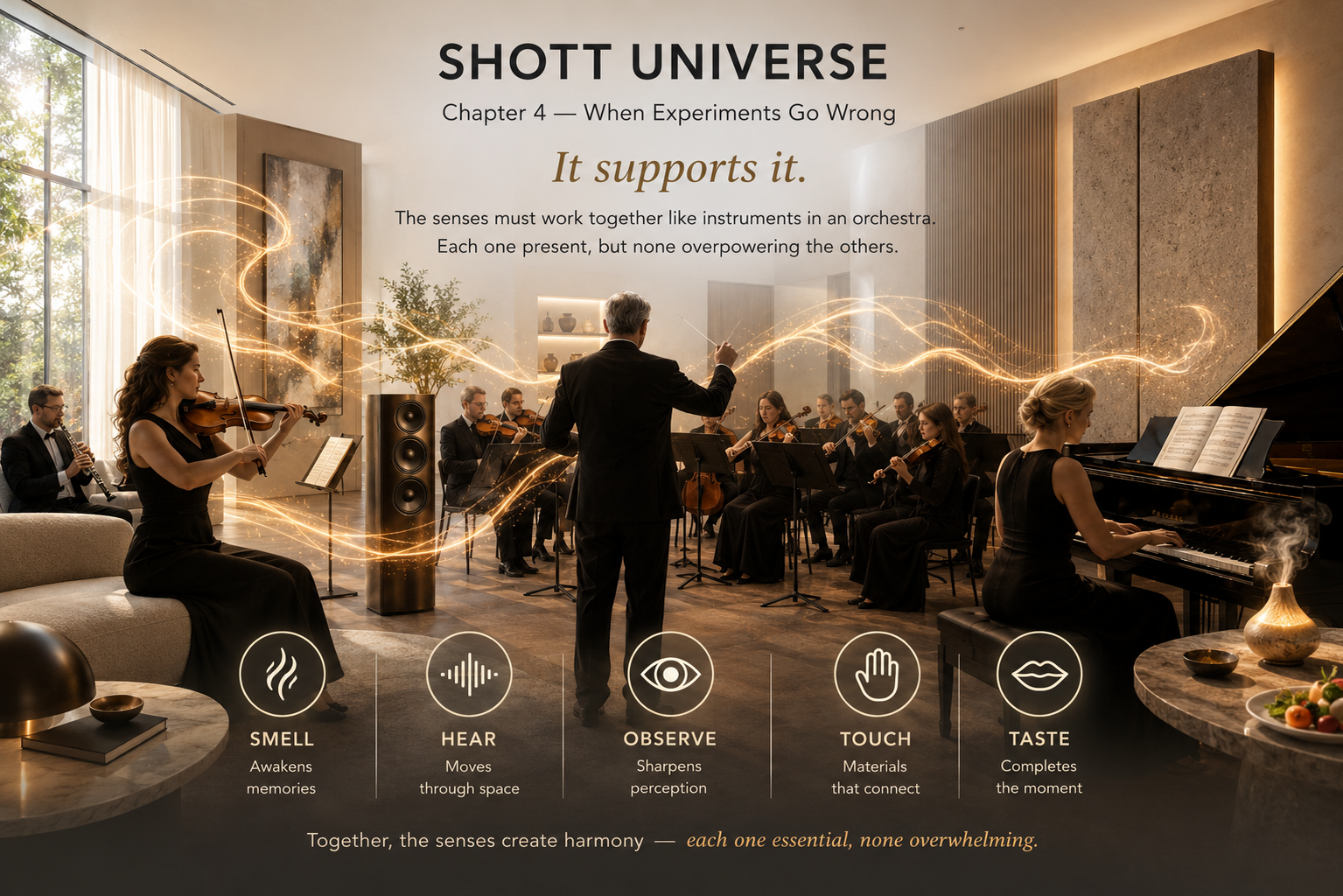
It supports it.
The senses must work together like instruments in an orchestra.
Each one present, but none overpowering the others.
From that moment forward, the engineers stopped thinking in terms of technology alone.
They began thinking like composers.
Not designing devices.
Not designing rooms.
But composing experiences.
And sometimes, the most important discoveries begin with something going wrong.